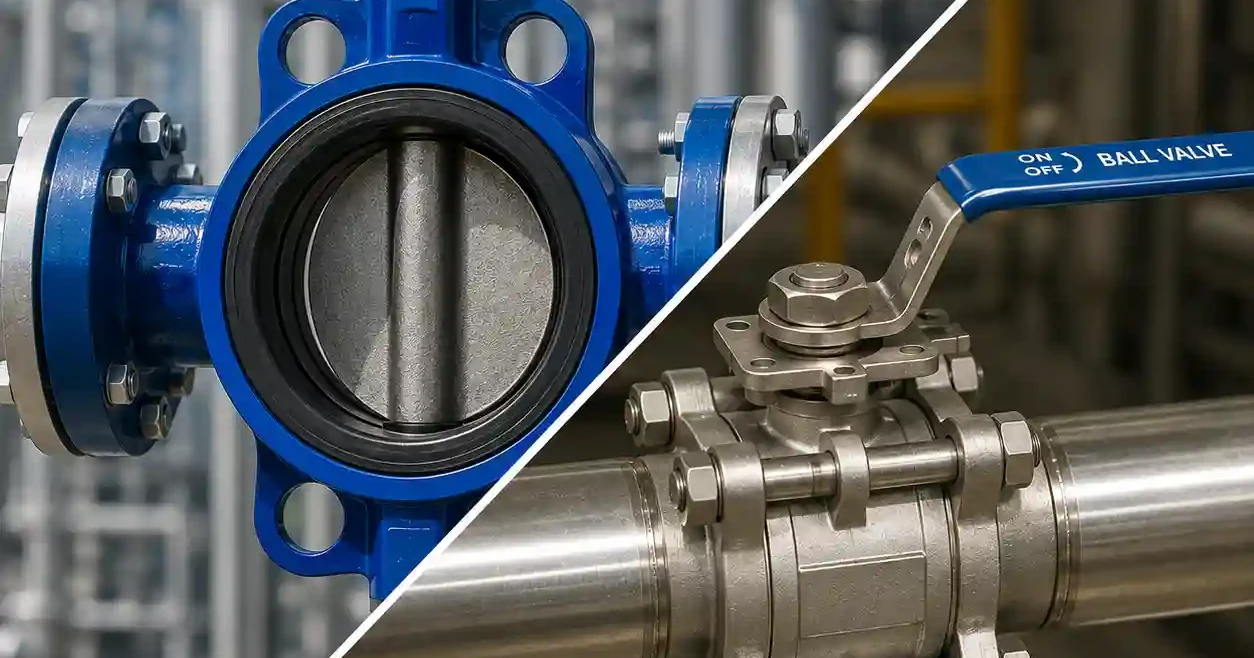

Butterfly valves and ball valves overlap on paper — both quarter-turn, both available soft-seated, both governed by mature standards. But they are different machines, and the differences compound with diameter.
Ball valves suit services that demand tight shutoff, full-bore flow, or frequent cycling; butterfly valves suit large-diameter, space- and budget-limited lines where a small pressure drop is acceptable. Smaller bores default to a ball valve. Large-bore water, HVAC and utility services default to a butterfly valve unless a specific duty requires a ball valve.
Two different machines behind one quarter-turn
“A butterfly valve is a short ring of body around a disc. A ball valve is a housing enclosing a machined sphere.”
Butterfly valve
The disc — a plate carried on a shaft across the bore — rotates a quarter-turn to close against a seat in the surrounding body ring.
- Wafer body clamps between two pipe flanges; lug body bolts to each flange independently
- API 609: concentric designs for utility duty, offset (eccentric) designs for class-rated service
- Offset geometry shifts the seat off the shaft centreline, so the disc cams out of contact as it opens
Ball valve
The ball — a bored sphere with a flow passage machined through it — rotates a quarter-turn so the passage faces across the line instead of along it.
- Smaller designs float the ball on its own seats
- Trunnion designs carry the ball on fixed bearings above and below
- Trunnion mounting takes the pressure load off the seats at higher classes and larger bores
Each family carries its own design lineage. Butterfly valves follow API 609 and EN 593 — EN 593's scope runs to DN 4000 and explicitly includes regulating duty. Ball valves follow API 608 and ISO 17292, with pressure–temperature ratings for both anchored in ASME B16.34. If the family is picked from a brand list before anyone has asked what the line has to do, the rest of the schedule is already a guess. Our guide to choosing an industrial valve function-first asks that question before a brand is on the table.
Same quarter-turn, different bets
“Shutoff is a specification, not a family trait.”
A butterfly-versus-ball comparison that starts at diameter or price can still put the wrong family on the line — a butterfly whose seat will not hold through cycling, or a ball valve the rack cannot carry.
DN — nominal bore · Face-to-face — the valve's installed length between pipe flanges · Rate A — no visually detectable seat leakage during test (ISO 5208) · Full bore — the valve opening matches the pipe bore.
| Decision criterion | Butterfly valve | Ball valve |
|---|---|---|
| Shutoff class | Soft-seated designs test to no-visible-leakage rates (ISO 5208 · API 598); offset seats extend tight shutoff to higher temperatures | Same tested rates; seats hold their class through frequent operating cycles |
| Flow path & pressure drop | Disc stays in the bore — moderate resistance, felt most at small sizes | Full-bore versions leave an unobstructed passage with near straight-pipe resistance (Crane TP-410) |
| Installed length & weight | Short wafer/lug face-to-face (ISO 5752); stays manageable as DN grows | Body length and weight climb steeply with diameter — supports become structural work |
| Throttling behaviour | Regulating and control duty inside EN 593's scope | On–off service by design (API 608); part-open operation wears the seats |
| Pigging & cleaning | Disc blocks the passage — not piggable | Full-bore versions pass pigs and scrapers Bores designated full, reduced or double-reduced (ISO 17292) |
| Governing standards | API 609 · EN 593 | API 608 · ISO 17292 Ratings for both families per ASME B16.34 |
| Cost direction by size | Advantage widens as diameter grows — fewer parts, less material | Competitive at small bore; the premium grows with size |
Which quarter-turn family to specify for a given service — shutoff, flow, length, throttling, pigging, standards and cost.
Sources: Crane TP-410 · API 609 · EN 593 · API 608 · ISO 17292 · ISO 5208 · API 598 · ISO 5752 · ASME B16.34.
Which criterion do you actually check first?
If shutoff class or the medium already rules a family out, diameter, torque and cost are not asked.
Shutoff class and medium-and-temperature checks can already reject a soft seat that cannot take the line temperature, or a body the medium will attack. The valve's length and weight have not been considered yet. If the line must pass pigs, hold near-zero pressure drop, or cycle tightly and often, the sequence ends early: it is a ball valve service. On smaller bores the price difference is modest, and the ball valve's machined seat support makes it the unremarkable, correct default.
From the mid diameters upward, the ball valve is no longer the unremarkable default. Installed length, weight on the rack, actuator size and price begin to dominate — and the butterfly valve's short body starts paying for itself at every size step. In practice, large-bore water, HVAC and utility services end at a butterfly valve unless a specific duty vetoes it.
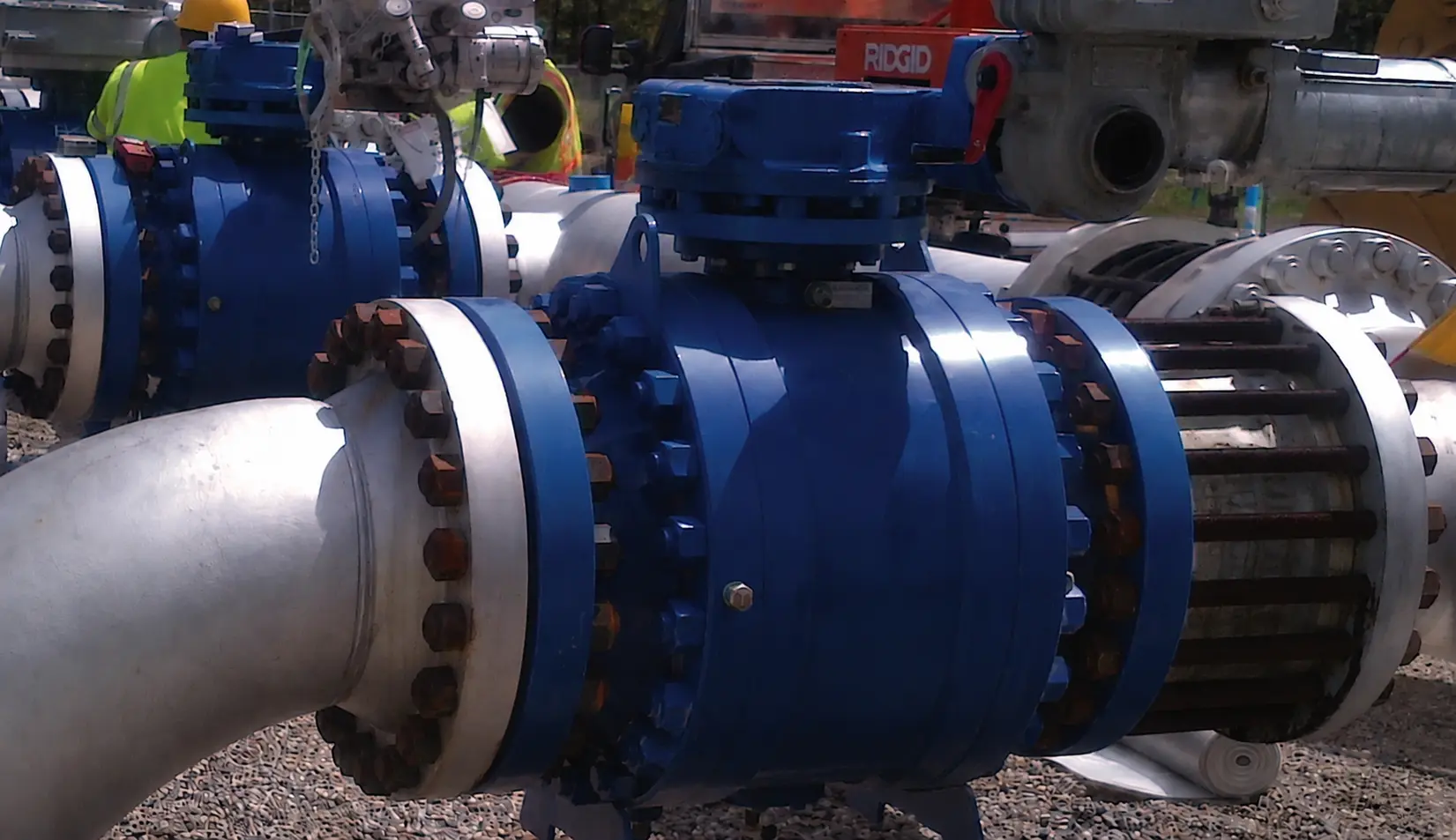
A heavy valve that a technician cannot reach without a crane does not get serviced on the planned interval — the job waits, which is the quiet cost pattern we traced in small equipment failures and industrial reliability.
After the family is chosen, the valve sizing calculator composes the nine-field enquiry from the line conditions. The chemical compatibility worksheet then writes the wetted path from the medium.
Valve specification fails in five patterns
Most of the cost of a wrong choice is committed at the specification table — these are the mistakes that commit it.
The blanket ball specification
Ball valves copied down the schedule as a safety default turn a large-diameter line into a structural project. Every size step multiplies weight, face-to-face length and cost. Decide per line size, not per column.
Shutoff written as a word, not a rate
"Bubble-tight" is not a specification. State the ISO 5208 leakage rate or API 598 acceptance the service actually needs — otherwise the factory acceptance test becomes an argument instead of a formality.
Throttling with an on-off valve
A standard ball valve held part-open puts its seats in the flow path. API 608 frames these valves as on-off equipment — sustained throttling duty belongs to butterfly designs or a dedicated control valve.
Actuation sized from a generic table
Seating torque is valve-specific and rises with pressure class and size. In practice, actuators chosen from generic tables stall at exactly the moments that matter — commissioning and emergency closure.
Fire-safe forgotten on soft seats
Soft seats seal tightly and burn readily. Where the medium is flammable, specify designs type-tested to API 607 / ISO 10497 — the test proves the valve still contains the process after its soft seal is gone.
None of this needs to be carried in your head. Work the list in order — the first three checks usually settle the family.
Butterfly valve vs ball valve: common questions
Which is better for throttling, a butterfly valve or a ball valve?
The butterfly valve is better for throttling than a ball valve. EN 593 covers butterfly valves for isolating, regulating and control duty, and the disc gives usable control through part of its travel. Standard ball valves are designed for on-off service under API 608 — held part-open, the seats sit in the flow and wear quickly. Where control accuracy matters, specify a control valve rather than either.
Can a butterfly valve provide tight shutoff like a ball valve?
Yes — a butterfly valve can match a ball valve on the seat test when the leakage class is stated. ISO 5208 Rate A and the API 598 resilient-seat acceptance both mean no visible leakage during the seat test. Offset butterfly designs extend tight shutoff to higher temperatures. Frequent cycling is where ball-valve seats keep that class in service.
Why are butterfly valves cheaper than ball valves at large diameters?
Butterfly valves are cheaper at large diameters because a disc in a short body uses far less material and machining than a bored sphere and its housing. As diameter grows, the ball design's material, machining and weight grow much faster. The gap in purchase price, installed length and pipework support widens with every size step.
When is a ball valve worth the extra cost?
A ball valve is worth the extra cost when the service needs tight shutoff through frequent cycling, full-bore flow, or a piggable line. A full-bore ball valve leaves an unobstructed passage — near straight-pipe pressure drop, and a path cleaning pigs can travel — and its seats hold tight shutoff through frequent operating cycles. On smaller lines the price difference is minor, and the ball valve is often the sensible default.
Do butterfly valves and ball valves follow the same standards?
No. Each family has its own design standards — API 609 and EN 593 for butterfly valves, API 608 and ISO 17292 for metal ball valves. They share the framework around them: ASME B16.34 pressure-temperature ratings, API 598 and ISO 5208 testing, and API 607 / ISO 10497 fire type-testing for soft-seated designs.
- API 609 — Butterfly Valves: Double-flanged, Lug- and Wafer-type — American Petroleum Institute.
- API 608 — Metal Ball Valves: Flanged, Threaded, and Welding Ends — American Petroleum Institute.
- ISO 17292 — Metal ball valves for petroleum, petrochemical and allied industries.
- EN 593 — Industrial valves: Metallic butterfly valves for general purposes.
- ASME B16.34 — Valves: Flanged, Threaded, and Welding End.
- API 598 — Valve Inspection and Testing — American Petroleum Institute.
- ISO 5208 — Industrial valves: Pressure testing of metallic valves.
- API 607 / ISO 10497 — Fire type-testing for quarter-turn valves with nonmetallic seats.
- ISO 5752 — Metal valves for use in flanged pipe systems: Face-to-face and centre-to-face dimensions.
- Crane Co. — Flow of Fluids Through Valves, Fittings and Pipe (Technical Paper No. 410).