

Pit water, mill slurry and transfer water at 1,624 m (JKIA's elevation) are three duties. The thinner air at that altitude has already eaten into net positive suction head available (NPSHA) — the pump's suction safety margin — before a catalogue is even opened.
Open-sump atmospheric head vs elevation
Standard atmosphere converted to metres of water (g = 9.81 m/s²). The elevation chart is not a site NPSHA measurement. HI 9.6.1 puts atmospheric head into the NPSHA calculation; ISO 9906 treats NPSHA as an installation number. Elevation: Kenya Meteorological Department (KMD) JKIA station, 1,624.0 m. Sea-level head here is 10.33 m; at JKIA the same method gives 8.49 m — about 1.8 m already gone before anyone opens a catalogue.
When the enquiry only says mining pump
A trash pump and a slurry pump both swallow solids. A trash pump that can pass a stone still does not resist mill abrasion. The same split shows up on valves — function-first on the valve side, before isolation is ever a question.
Dewatering
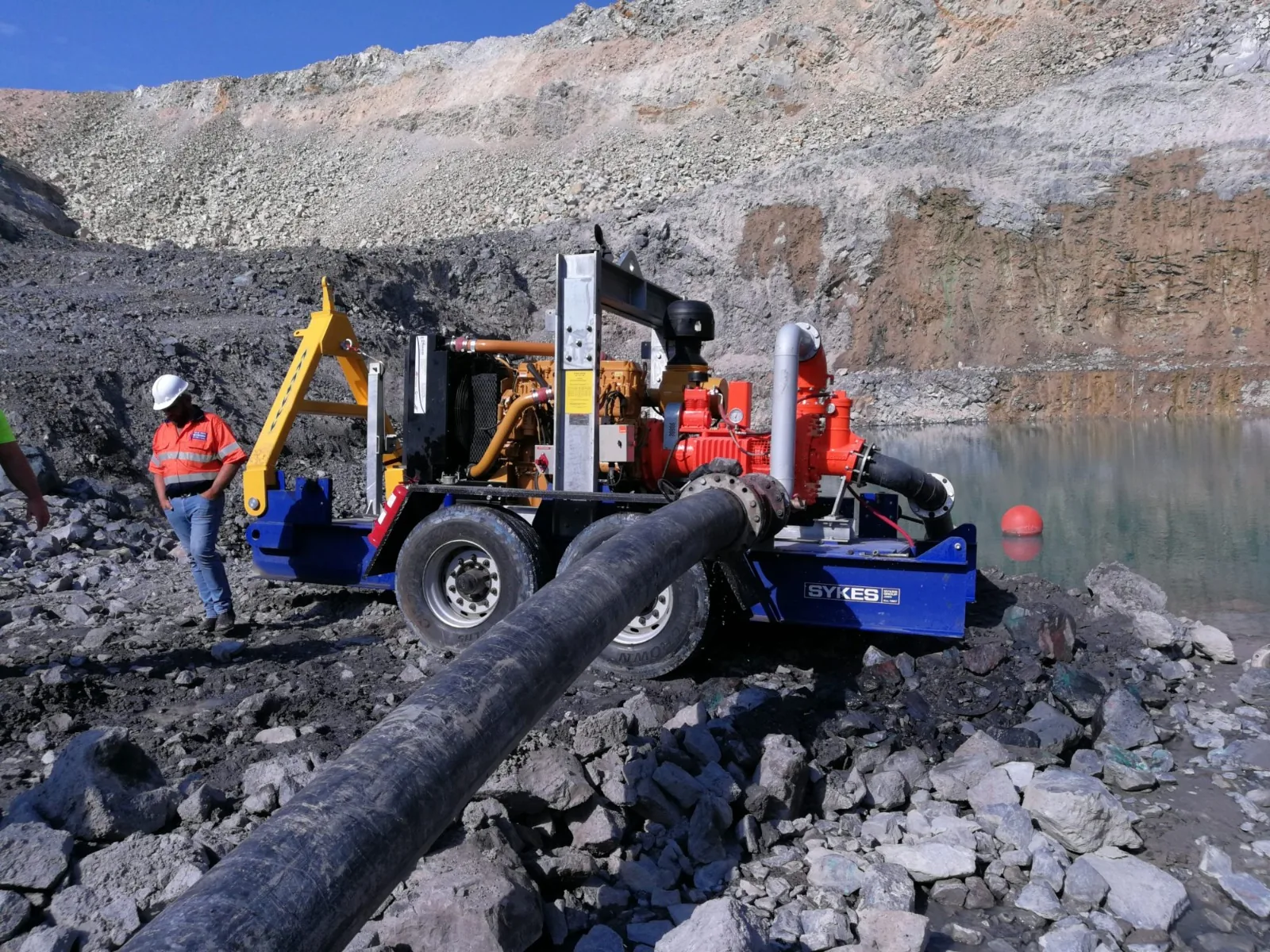
Rain and groundwater. Suction lift. Solids passage through the impeller, while mill abrasion is a different wet-end problem. Godwin's published dry-prime envelope on that family is 28 ft (8.5 m), with a liquid-bath seal that can sit dry. That envelope is a dewatering limit.
Slurry
The mixture wears the wet end — the pump parts in contact with the liquid. Below a critical velocity it settles and blocks the line. HI 12 exists because a centrifugal that ignores wear and settling will not run, or will not last. Rubber linings stay inside the solids-size envelope HI 12 now flags.
Transfer
Long line, still water. ISO 9906 acceptance is for liquids that behave as clean cold water. Send a clean-water impeller into quarry sand and the wet end fails.
Chrome, rubber, and soda brine
"High-chrome iron is an abrasion answer. It is not a brine answer."
ASTM G75 ranks how abrasive a slurry is (Miller Number, 27% chromium iron wear blocks) and how a candidate material answers that slurry (SAR, slurry abrasion response). By ASTM's own rule of thumb, a slurry with a Miller Number of about 50 or lower can be pumped with minor abrasive damage; above a Miller Number of 50, take precautions — greater damage is expected. ASTM's Miller Number ranks abrasivity; liner life still has to be estimated from the actual duty.
Magadi-class soda brine is a different attack. ACS describes it as hyperalkaline saline soda chemistry — sodium carbonate, chloride, bicarbonate, silica. USGS measured Magadi-basin waters from dilute inflow below 0.1 g/kg dissolved solids to residual brines above 300 g/kg. Magadi-class liquor at those dissolved-solids extremes attacks by corrosion and by its sheer density. Chrome versus rubber is the wrong race for that liquor.
Three liquids. Three attacks. Public geology and standards, not site-specific case studies.
| Liquid | Attack | Wrong machine |
|---|---|---|
| Alkaline soda brine | Hyperalkaline saline soda. Magadi-type. | A high-chrome mill pump specified as if the problem were sand. |
| Hard-rock slurry | Ore solids in water. Size, concentration and hardness still have to be measured. | A clean-water centrifugal, or rubber outside HI 12's solids-size envelope. |
| Quarry sand | Silica in water. HI 12 lists sand, rock and slurry as the industries the standard is for. | A trash pump that passes a stone and is still not a slurry pump. |
What rainfall number actually runs the dewatering skid?
KMD's climate record is bimodal: long rains March–May (MAM), short rains October–December (OND). A third season, June–August, sits on the coast, the western highlands and the Lake Victoria Basin. MAM is the main rainfall season. A dewatering skid sized on the yearly mean is short on the day the long rains arrive as a peak. The mill slurry duty does not care which month it is.
KMD seasons, not millimetres
Presence of a KMD season, not a rainfall quantity. No millimetre axis — KMD publishes season presence, not a pit-specific rainfall hydrograph.
Grid power or diesel decides the driver, the primer and the fuel path, not just the motor. Godwin's catalogue puts diesel on stand-alone remote sites and electric where electricity is there and refuelling is the problem.
Prime is a separate machine limit from that driver choice. Submergence is a third number. HI 9.8 sets a minimum submergence to keep an air-core vortex out of the bell. The formula is S = D(1 + 2.3 FD), where S is that minimum depth, D is the bell diameter, and FD is the factor given in HI 9.8. That depth may still need to grow to satisfy NPSHR (net positive suction head required). Air in the bell is how a quiet sump becomes vibration and lost head.
How the wrong skid actually dies
- Clean water, sand
- A clean-water pump specified for quarry sand fails ISO 9906's clean-cold-water basis. HI 12 is the standard for mixtures that wear and settle; calling the liquid dirty does not substitute for HI 12.
- Mean rainfall
- A dewatering skid sized on KMD's yearly rainfall mean is short on the day the pit's long-rains peak arrives.
- No prime
- NPSHA at elevation, suction lift, and a self-primer are three facts. Godwin's published dry-prime envelope of 28 ft (8.5 m) is a dewatering limit. It does not replace those three facts.
- Empty sump
- A seal designed to run wet overheats when the pit empties. A liquid-bath seal is a published dry-run design; any other seal on an emptied sump is a failed seal on a dry afternoon.
- Shaft power at two heads
- ISO 9906 maximum shaft power for every specified duty (P2,max) has to cover every specified operating condition. The attractive point on the curve does not cover the other duty's shaft power.
- Diesel quoted on the wet end
- A quotation that prices diesel against electric on the wet-end unit alone is comparing incomplete machines: engine, primer and fuel against motor and cable.
- Submergence from another sump
- HI 9.8 keeps the vortex out of the bell; NPSHR is a different number. Meeting HI 9.8 submergence and missing NPSHR still puts air in the pump.
Flow, head, specific gravity, solids and suction all go into the pump duty calculator — but only after the wet-end family matches the liquid. A kW that matches one head and misses the other is a trip at runout — the far end of the pump curve, where flow is highest and the motor draws the most power.
What still has to be checked on the pad
Can a sea-level NPSHR curve be used unchanged at JKIA's 1,624 m?
No. Open-sump atmospheric head falls from 10.33 m at sea level to about 8.49 m at JKIA's 1,624 m — about 1.8 m already gone before a catalogue is opened. HI 9.6.1 puts atmospheric head into the NPSHA calculation; ISO 9906 treats the finished NPSHA as an installation number, not a curve constant.
Does KMD's June–August third rains season apply to every Kenyan pit?
No. KMD places the June–August third season on the coast, the western highlands and the Lake Victoria Basin, not on every site. A dewatering skid sized on the yearly mean is still short on the day the long rains (March–May) arrive as a peak.
Does HI 9.8 minimum submergence replace an NPSHR check?
No. HI 9.8 sets a minimum submergence to keep an air-core vortex out of the bell: S = D(1 + 2.3 FD), where S is that minimum depth, D is the bell diameter, and FD is the factor given in HI 9.8. That depth may still need to grow to satisfy NPSHR (net positive suction head required). Meeting the vortex rule and missing NPSHR still puts air in the pump.
Can diesel and electric transfer pumps be compared on wet-end price alone?
No. A diesel self-primer needs an engine, primer and fuel path; an electric centrifugal needs a motor and cable. Godwin's catalogue puts diesel on stand-alone remote sites and electric where grid power exists and refuelling is impractical — pricing the wet-end unit alone compares two incomplete machines.
Is a rubber-lined slurry pump always the safe choice for abrasive duty?
No. HI 12 sets a maximum recommended solids size for rubber linings — coarse or sharp particles outside that envelope cut the elastomer faster than the metal it was meant to protect. A hard-rock slurry with unmeasured particle size can put a rubber liner outside its own standard before it is ever installed.
- ISO 9906:2012 — Rotodynamic pumps — Hydraulic performance acceptance tests — Grades 1, 2 and 3.
- ASTM G75-24 — Standard Test Method for Determination of Slurry Abrasivity (Miller Number) and SAR Number.
- ANSI/HI 12.1-12.6 — Rotodynamic Centrifugal Slurry Pumps for Nomenclature, Definitions, Application, and Operation — Hydraulic Institute.
- ANSI/HI 9.6.1-2024 — Rotodynamic Pumps — Guideline for NPSH Margin (atmospheric head; elevation examples; slurry-pump margin).
- ANSI/HI 9.8 — Rotodynamic Pumps for Pump Intake Design — minimum submergence, Hydraulic Institute Data Tool excerpt.
- Kenya Meteorological Department — State of the Climate Kenya 2022; MAM 2026 Long Rains outlook; JKIA station elevation 1,624.0 m.
- Melesse et al., Crystal Growth & Design 2022, 22, 2307 — Lake Magadi soda brine chemistry class.
- Jones, Eugster, Rettig — Hydrochemistry of the Lake Magadi basin, Kenya, USGS.
- Xylem/Godwin — Godwin US Product Catalog 07.2015 (dry-prime, run-dry, diesel/electric operating limits).
- ISO 2533 / ICAO standard atmosphere — barometric pressure used for the elevation chart. Converted to metres of water; not a site NPSHA measurement.